In the 1960s Some Artists Looked to Art Making Itself as a Source of Investigation
Manufactures and Features
Art Movement: Conceptual Art
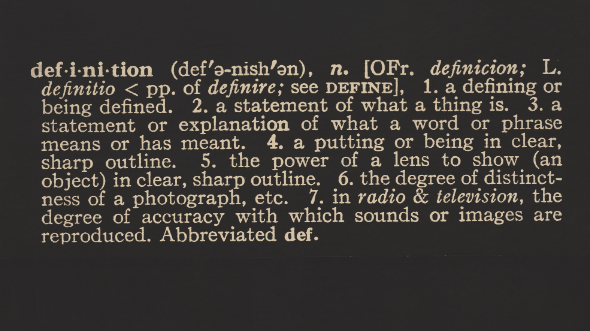
"The 'purest' definition of conceptual art would be that it is an enquiry into the foundations of the concept 'art'"
Joseph Kosuth
Conceptual Art definition:
Unpacking the term Conceptual art is not quite equally straightforward as other art movements. It's easy to get confused past the different ways in which the word is used. While it most normally refers to the fine art movement between the 1960s and 1970s that emerged in the United States, there are several other ways of understanding it. What exactly does this discussion connote? When was Conceptualism an art move, and does information technology still exist? In his comprehensive volumeConceptual Art, fine art historian Paul Wood distinguishes between the different means the term is used:
1: Conceptualism is often used as a negative term for what people dislike about contemporary fine art which revolves around the concept.
ii: Conceptualism refers to the Anglo-American art motion that blossomed in the 1960s and 1970s. The idea, planning and production process of the artwork were seen as more important than the actual result.
iii: A more expanded notion of Conceptualism holds that men and women in all corners of the world had been working in a conceptual manner since the 1950s on themes ranging from imperialism to personal identity. In this sense, Conceptualism becomes a Global Conceptualism.
This article volition explore both the Anglo-American and the global Conceptual art movement.
What is Conceptual Fine art?
Conceptual art emerged as an art motion in the 1960s, critiquing the previously ruling modernist move and its focus on the aesthetic. The term is ordinarily used to refer to fine art from the mid-1960s to the mid-1970s. In Conceptualism, the idea or concept backside the piece of work of art became more important than the actual technical skill or aesthetic. Conceptual artists used whichever materials and forms were most appropriate to get their ideas across. This resulted in vastly different types of artworks that could look like almost anything – from performance to writing to everyday objects. The artists explored the possibilities of fine art-as-thought and fine art-as-cognition, using linguistic, mathematical, and process-oriented dimensions of thought as well every bit invisible systems, structures and processes for their art.
Fundamental dates: Mid-1960s to mid-1970s
Key regions: Us, Soviet Wedlock, Japan, Latin America, Europe
Cardinal words: Concept, idea, linguistic communication, transitional, political, postmodernist art
Central artists: Sol LeWitt, Joseph Kosuth, Mel Bochner, Hanne Darboven, Jan Dibbets, Hans Haacke, On Kawara, Lawrence Weiner, Ian Fire, Mel Ramsen, Yoko Ono, John Baldessari, Art & Language grouping, Marina Abramović
The origins of Conceptual Art
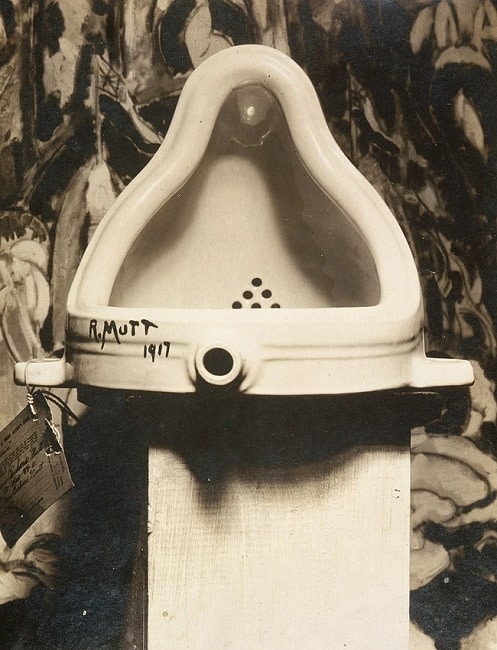
Although Conceptual fine art was showtime divers in the 1960s, its origins trace back to 1917, when Marcel Duchamp famously bought a urinal from a plumber's shop and submitted it as a sculpture in an open up sculpture exhibition in New York, for which he was on the selection committee. The jury rejected the piece of work, deeming information technology immoral, and refusing to have it as art. Duchamp's questioning of where the boundaries of art prevarication and his critique of the art institution paved the way for Conceptual fine art.
Fluxus
In the early 1960s, the term 'concept art' was already in use by members of the Fluxus motility like Henry Flynt. Fluxus was a group that embraced artists from Asia, Europe and the United States. The movement was all near creating an open up attitude towards art, far removed from modernism's exclusivity. Fluxus artists were interested in broadening the range of reference of the aesthetic towards anything, from an object to a sound or an activeness. Famous Fluxus artists include Yoko Ono, who was active in a broad range of Fluxus activities in both New York and her native Japan, and Joseph Beuys in Germany. Though not alwaysexactly accounted part of the Conceptual fine art movement, Fluxus is without a doubt i of its influences. It was an of import tendency on the aforementioned wavelength every bit Conceptualism, and its artists are often regarded every bit Conceptual artists.
Frank Stella's Black Paintings
In the late 1950s and early 1960s, Frank Stella created his serial of Black Paintings, which marked a crucial signal of fracture between Modernism and Counter-Modernist practices. This series of works would atomic number 82 to the emergence of Minimalist and Conceptual art. The bespeak of these works was to literally emphasise and echo the shape of the canvas, getting the work off the wall and into iii-dimensional space. This was an attack on Modernism that gave rise to something that was entirely anti-form. The piece of work of art became near actions and ideas, and from this point onwards, information technology seemed like the floodgates had opened and artists had moved into totally new territory. Modernism had actually come to an end.
Sol LeWitt's Paragraphs on Conceptual Art
Sol LeWitt's 1967 article 'Paragraphs on Conceptual Fine art' inArtforum was one of the most important writings on Conceptualism. The commodity presented Conceptual art as the new avant-garde movement. In fact, the term 'Conceptual art' appeared for the first time in this article. The opening of LeWitt'south article has come up to plant the general argument of a Conceptual arroyo: 'In Conceptual art the idea or concept is the virtually of import attribute of the work. When an creative person uses a Conceptual form in fine art, it means that all of the planning and decisions are made beforehand and the execution is a perfunctory affair. The idea becomes a motorcar that makes the fine art.'
Famous Conceptual Art artists
Joseph Kosuth
Conceptual art as a clear motion started emerging in the late-1960s. In 1967, Joseph Kosuth organised the exhibitionsNonanthropomorphic ArtandNormal Artin New York, where works past Kosuth himself and Christine Kozlov were shown. In his notes accompanying the exhibition, Kosuth wrote: 'The actual works of art are the ideas.' In the same year, he exhibited his series ofTitled(Art every bit Thought equally Idea).This series of works consisted not of visual imagery, but of words that were at the core of the debate surrounding the condition of modern art – 'meaning', 'object', 'representation', and 'theory,' amid others.
Fine art & Language Group
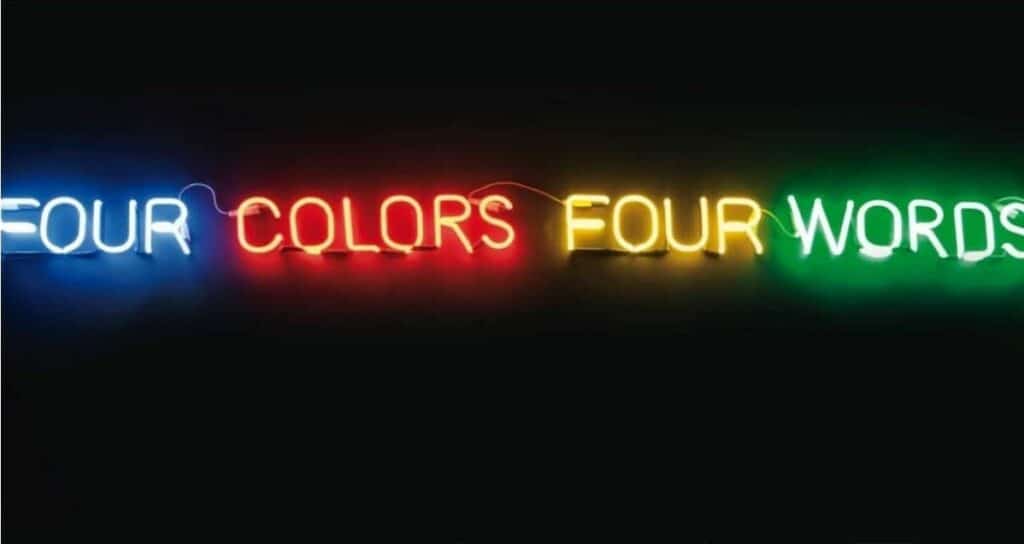
Meanwhile in England, the Art & Language Group were investigating the implications of suggesting more and more complex objects as works of art (examples include a column of air, Oxfordshire and the French Ground forces). The kickoff generation of the Art & Language Group was formed by Terry Atkinson, Michael Baldwin, David Bainbridge and Harold Hurrell in 1966-67. Later, the group likewise expanded to the The states. In 1972, they produced the Art & LanguageAlphabetize 01for Documenta V. This was an installation consisting of a group of eight filing cabinets containing 87 texts from theArt-Language periodical.
Lucy Lippard'southSix Years
Lucy Lippard's bookSix Years, covering the first years of the Conceptual fine art move (1966-1972), came out in 1973. In keeping with the confusing and complex nature of Conceptual art, the American artist Mel Bochner condemned her account as confusing and arbitrary. Years after, Lippard would argue that virtually accounts of Conceptualism were faulty and that nobody's memory of the actual events related to the development of Conceptual art could exist trusted – not even the artists'.
Conceptualism in Europe
Equally stated before, Conceptualism was non just important in the Us and England, but was too widely explored and adult in other parts of the world, where the piece of work was often far more politicised. In France, around the time of the 1968 student uprisings, Daniel Buren was creating fine art that was meant to challenge and critique the establishment. His aim was not to describe attention to the paintings themselves but to the expectations created by the art context they were placed in. In Italy, Arte Povera emerged in 1967, focused effectually making art without the restraints of traditional practices and materials.
Conceptualism in Latin America
In Latin America, artists opted for more than directly political responses in their work than Conceptual artists in N America and Western Europe. The Brazilian artist Cildo Meireles reintroduced the readymade with hisInsertions into Ideological Circuitsseries (1969). He would interfere with objects from systems of apportionment like depository financial institution notes and Coca-Cola bottles past stamping political letters onto them and returning them into the system similar that.
Conceptualism in Soviet Union
In the Soviet Marriage, fine art critic Boris Groys labelled a group of Russian artists agile in the 1970s the 'Moscow Conceptualists'. They mixed Soviet Socialist Realism with American Pop and Western Conceptualism.
Gimmicky Conceptual Art and Conceptualism
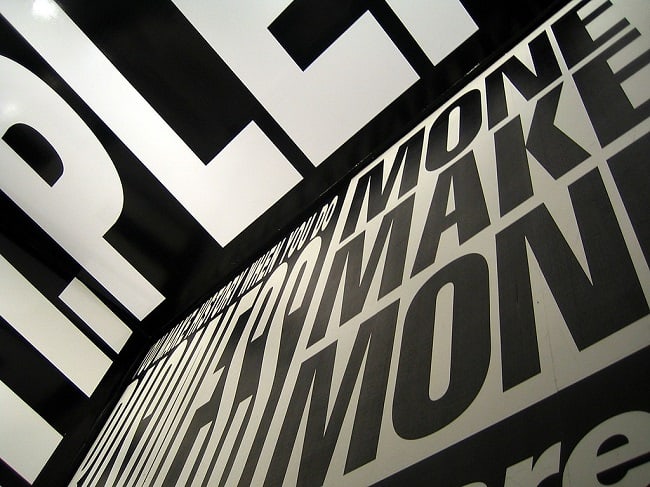
Conceptualism in contemporary do is oftentimes referred to every bit Gimmicky Conceptualism. Gimmicky Conceptual artworks oftentimes utilize interdisciplinary approaches and audition participation, and critique institutions, political systems and structures, and hierarchies. Artists who conspicuously utilise various techniques and strategies associated with Conceptual art include Jenny Holzer and her employ of linguistic communication, Sherrie Levine and her photographic critique of originality, Cindy Sherman and her play with identity, and Barbara Kruger's employ of text and photography.
Every bit nosotros've explored the complex and extensive history and presence of Conceptual art, several things come up to mind. One of its greatest strengths was taking the responsibility to truly investigate the nature of fine art and institutions. At times, information technology was an art of resistance to the dominant order. At other times, it was a cynical mirror held upward to the art world, or a securely philosophical undertaking. Many artists despised existence put in the box of Conceptual art, as they despised beingness put into any box. Yet, we take attempted to draw certain lines between various artists, events and idea systems that circled around a similar orbit for some fourth dimension and which can be better understood under the umbrella of Conceptualism.
Conceptual art FAQ
What does conceptual mean in art?
When an artist uses a conceptual course of fine art, it means that all of the planning and arrangements are made beforehand, and the execution is a more a shallow process. In conceptual fine art, the process behind the piece of work is more than important than the finished artwork.
What are the characteristics of Conceptual Art?
Conceptual Art is mainly focused on "ideas and purposes" rather than the "works of art" (paintings, sculptures, and other valuable objects). It is characterised by the employ of different media and supports, along with a variety of temporary everyday materials and "ready-made objects".
Who is the father of Conceptual Art?
Marcel Duchamp is often known to be the forefather of Conceptual Art. He is all-time known for his readymade works, similar Fountain, the famous urinal that he designated as art in 1917 and that is seen as the get-go conceptual artwork in art history.
Relevantsources to learn more
Read more near Art Movements and Styles Throughout History here
Piero Manzoni and his Merda d'Artista: Can shit be art and who decides?
Learn more than virtually Conceptualism Earlier, During, and After Conceptual Art by Terry Smith
Larn more about the Art Term on Tate Publishing
Source: https://magazine.artland.com/conceptual-art/
0 Response to "In the 1960s Some Artists Looked to Art Making Itself as a Source of Investigation"
Postar um comentário